

SLS Beach Risk Assessments & Audits
The Challenge
Someone has to decide whether a beach is safe enough, and say so in writing.
Beach safety assessment is formal work: an assessor visits a location, examines its infrastructure — signage, access ways, viewing platforms, rescue equipment, hazard markers — records the risks each one presents, and issues recommendations to the land manager, usually a local council. The output is a report that carries weight. It informs budgets, drives capital works, and is the document people reach for after something goes wrong.
Done on paper and in word processors across hundreds of locations and multiple states, that process has predictable failure modes. Assessments are inconsistent between assessors. Risks are described in incompatible language. Recommendations get made and then lost. And nobody can answer the question that matters most: what did we recommend for this beach last time, and was it done?
The Solution
Nano Solutions built the platform that structures this work end to end — the system now known internally as Beach Management.
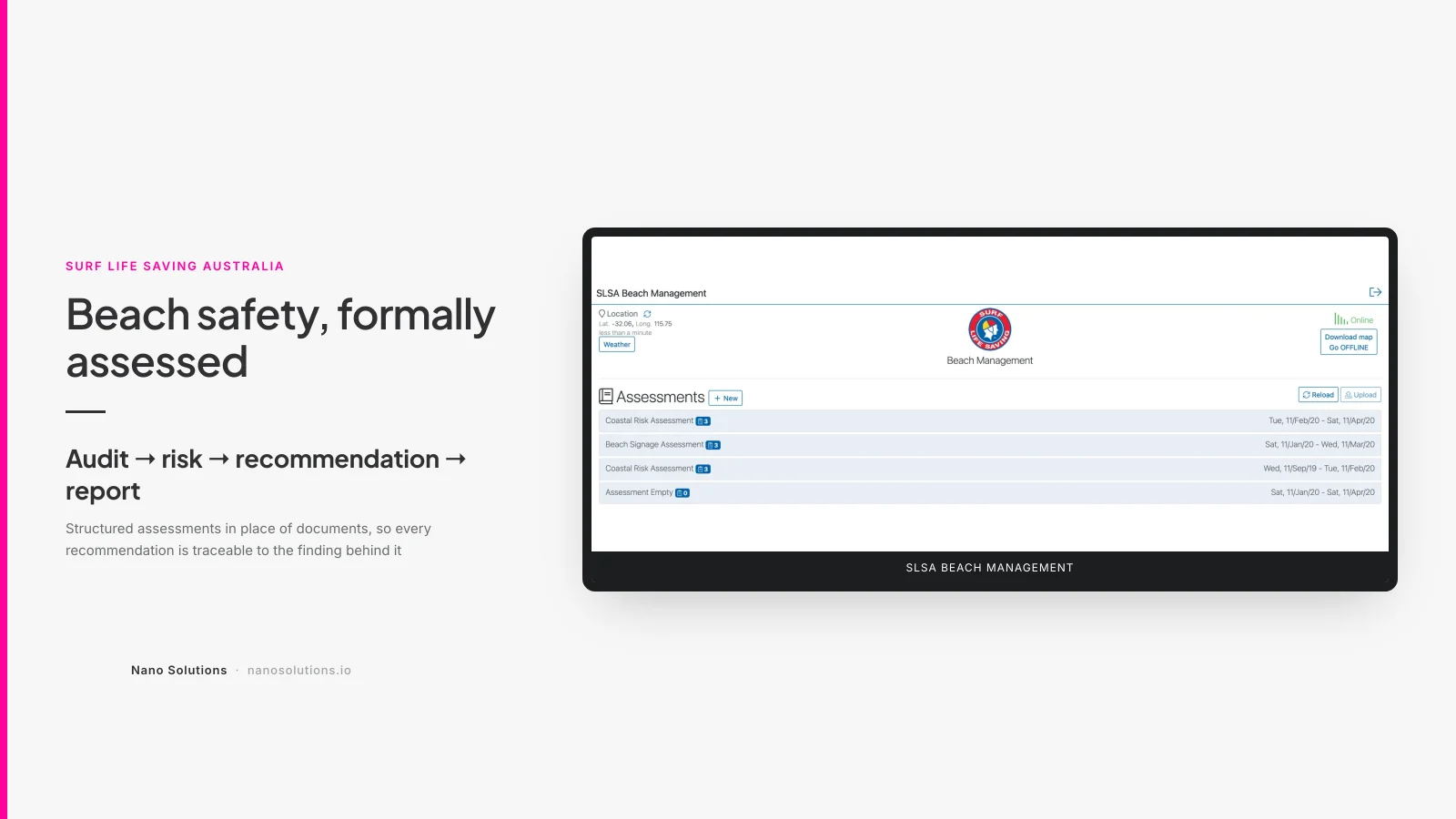
A structured assessment model
The domain is modelled properly rather than as documents with fields:
- An assessment is a piece of work at a beach, owned by an assessor
- An audit within it examines the location systematically
- Audit objects are the individual things being examined, each with a type and subtype drawn from a maintained taxonomy so a hazard sign is the same category of thing in every state
- Risks and hazards attach to those objects, not to free text
- Recommendations attach to the object or risk that prompted them, so every recommendation is traceable to the finding behind it
- Comments capture the assessor's judgement without contaminating the structured record
- Supporting media is attached at the point of observation
Because risks and recommendations are records rather than paragraphs, they can be queried across beaches, states and years. "Show me every unresolved recommendation about beach access" becomes a query instead of a research project.
Reports as generated artefacts
The deliverable is still a report, so report generation is a first-class part of the platform: templated documents assembled from the structured data, organised into folders with a navigable tree, previewable before issue, and exportable for distribution to councils and land managers.
Templated generation is what makes consistency real. Two assessors examining two beaches produce reports with the same structure, the same terminology and the same rigour, because the document is generated from a shared model rather than typed from a shared intention.
Connected to the wider operation
The platform authenticates against Surf Life Saving's national membership systems and shares beach and organisational entity data with the rest of the estate, so assessors carry the permissions their role gives them and the beaches they assess are the same beaches the public sees on BeachSafe.
Engineered like something people rely on
Continuous integration on every change, automated end-to-end testing, visual regression testing so report layouts do not silently break, and containerised deployments. Report templates have their own test path — because a report that renders wrong is worse than one that fails to render.
The Results
- A single structured model for beach safety assessment across states and assessors
- Risks and recommendations as queryable records, so recommendation history per beach is answerable
- Consistent generated reports from templates rather than hand-assembled documents
- A maintained object taxonomy so findings are comparable nationally
- Tied into national membership and beach data rather than standing alone
- Report rendering under visual regression testing, so layout regressions are caught before issue
Technology
Laravel with a Vue.js frontend, a polymorphic risk and recommendation model over a typed audit-object taxonomy, Spatie Media Library for observational evidence, templated report generation with folder-tree organisation, preview and export. Member authentication against national SLS systems with shared entity data. Docker deployments through GitLab CI, Cypress end-to-end tests and Percy visual regression, including on report templates. A Capacitor mobile companion lets field teams work against the same data.
See also: SLS Beach Management — the wider platform, SLSA BeachSafe — the public face of the same beach data, and SLSA Operations App — the field tool used by patrols.
Related Nano Solutions services: Software Development · Systems Integration · Cloud Maintenance. WA government agencies can engage us directly through our CUAICTS2021 panel listing.
