

SLSA Bluebottle Forecast
The Challenge
Bluebottle stings are the most common reason people need first aid at an Australian beach. They are also, in principle, predictable — whether bluebottles wash ashore depends on wind, temperature, the season, and the shape and orientation of the beach itself.
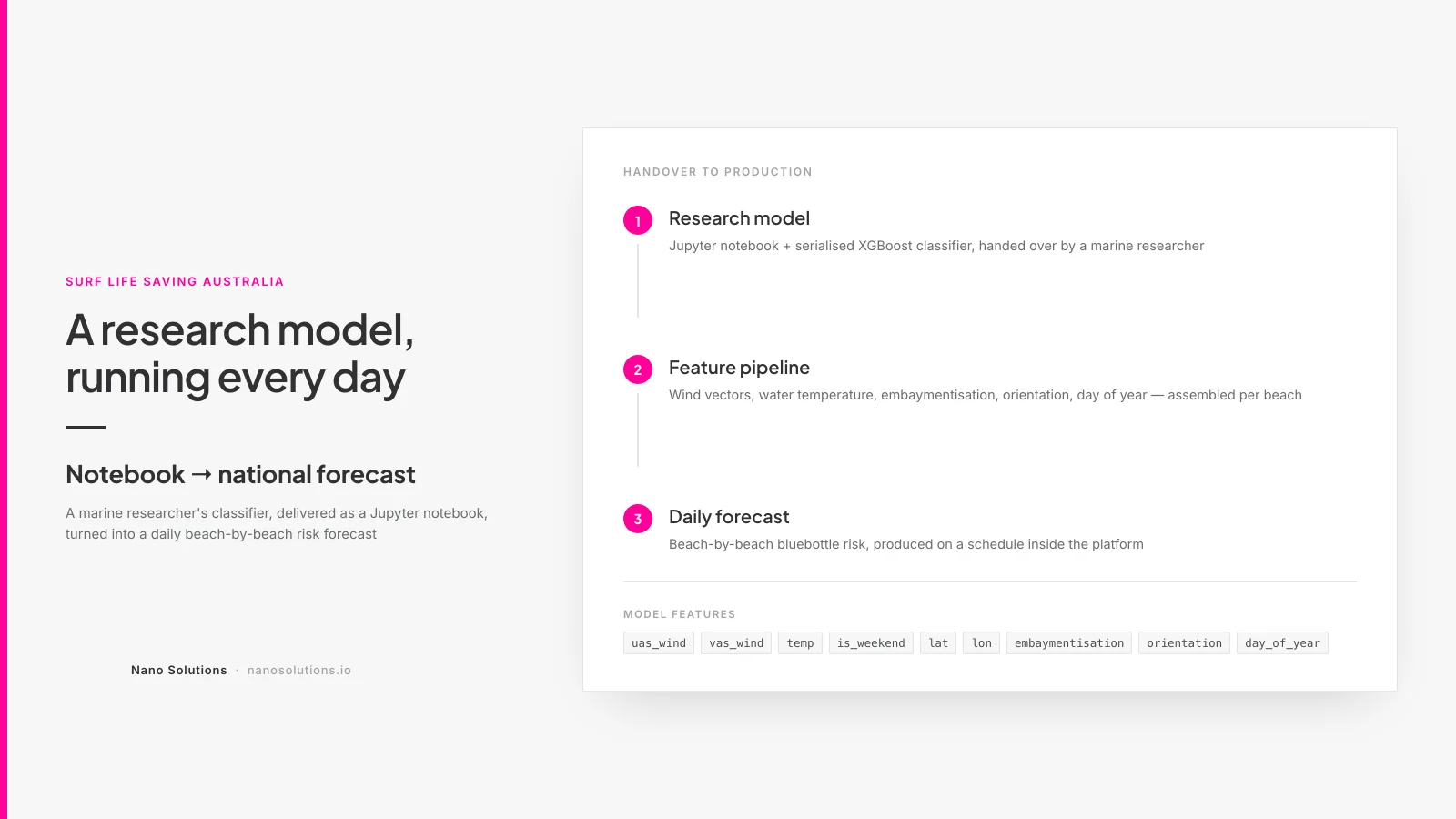
Researchers had built a model that captured this: a gradient-boosted classifier trained on coastal data, taking wind components, temperature, day of year, whether it was a weekend, and per-beach physical characteristics including embaymentisation and coastal orientation.
It worked. It was also a Jupyter notebook with a hard-coded path to a researcher's laptop, reading a CSV, producing a one-off answer for one day. There was no path from that to "tell every beach-goer in the country what today's risk is."
The Solution
Nano Solutions productionised the model — taking it from research artefact to a scheduled forecast service inside the BeachSafe platform.
From notebook to service
- The trained model was extracted from the research code into a portable serialised form that could be loaded and evaluated on demand, rather than re-fitted in a notebook
- Feature assembly moved into the application. The model needs wind components, temperature, day of year and weekend flags — the first two come from the marine data pipeline already ingesting Bureau of Meteorology forecasts, so the inputs were derived from live data instead of a static CSV
- Per-beach physical attributes — latitude, longitude, embaymentisation and orientation — became first-class data on the beach records, so every beach carries its own model inputs
- A dedicated forecast service runs the prediction and persists the result against each beach, so the public site and mobile apps read a stored forecast rather than computing one per request
- Export and distribution so the forecast can be consumed beyond the website
Making it operable
The prediction runs on a schedule alongside the rest of the data pipeline. Predictions are stored as records, which means they can be inspected, compared against what actually happened, and used to evaluate the model over time — the difference between a model that was deployed once and a model that can be improved.
The same productionisation approach was applied to a second hazard: algal bloom data, imported from an external source and surfaced as its own beach-level warning with an independently controllable display switch, so a hazard can be turned on for the public the moment the data is trustworthy.
The Results
- A research model turned into a daily, national, per-beach forecast — running in production, not in a notebook
- Live inputs instead of static ones — the model consumes the same Bureau of Meteorology feeds that drive the rest of BeachSafe
- A repeatable pattern, applied a second time for algal bloom warnings
- Predictions stored, not just displayed, so model performance can be reviewed after the fact
Technology
The trained gradient-boosted classifier is loaded from a serialised model artefact and evaluated by a dedicated Laravel forecast service, with model features assembled from the existing Bureau of Meteorology ingestion pipeline plus per-beach geospatial attributes. Predictions are persisted per beach on a scheduled run, with a separate export path for downstream consumers. Algal bloom warnings follow the same import-predict-persist-display shape with an independent feature switch.
See also: SLSA Marine Data Pipeline — the data layer that supplies the model's inputs, and SLSA BeachSafe — where the forecast reaches the public.
Related Nano Solutions services: Software Development · Systems Integration · Cloud Maintenance. WA government agencies can engage us directly through our CUAICTS2021 panel listing.
